In the ΛCDM, this force would supposedly arise from the curvature of a non‑existent spacetime. The Big Bang paradigm provides no physical substrate to curve. Spacetime is an abstract mathematical object, without minimal presence (unlike Faraday or UG.NUG). A physical deformation is therefore attributed to a non‑physical structure, which constitutes a major fundamental contradiction.
In the UG.NUG reading, gravity is the static reaction of the GRID in the presence of geometric objects. It is not a fundamental force, has no quantum carrier, and cannot be reduced to a quantum field theory. It is therefore not quantifiable in the physical sense — not because it is immeasurable, but because it does not belong to the quantum regime. It is measurable only on Earth, through its effect on a physical reference (e.g., one liter of water).
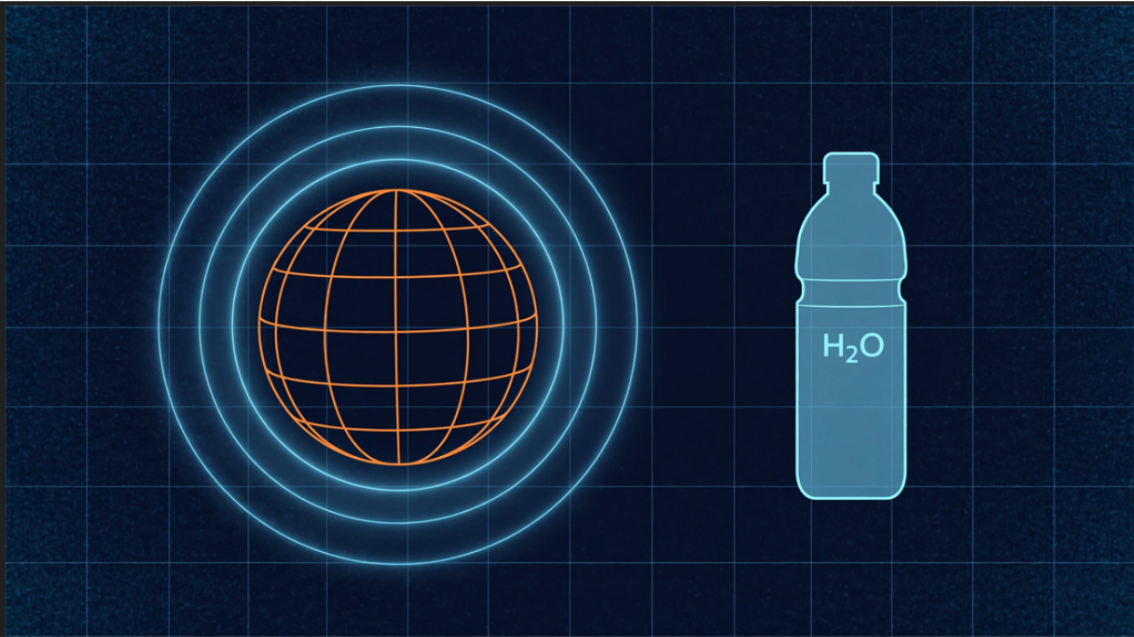
And the only real measurement of gravity is simply the pressure it exerts on an everyday object. Take one liter of water. Whatever its container — a thin bottle, a wide one, or a balloon — it will always weigh one kilogram. Well, without any grandiloquent formula, Newtonian or Einsteinian, I can tell you that gravity at Earth’s surface is 1 kilogram‑force (1 kgf). Assuming our water balloon would float in weightlessness and weighs the equivalent of one liter of water on Earth, the result is beyond doubt.
In the Big Bang Paradigm, gravity at Earth’s surface is computed in several steps. For non‑specialists, understanding the equations is irrelevant. It only serves to demonstrate an absurd complexity to reach the same result than without equations:
We assume Earth has a mass M.
- This mass is not measured directly: it is inferred from other models (orbits, constants, etc.).
- We assume gravity follows Newton’s law:
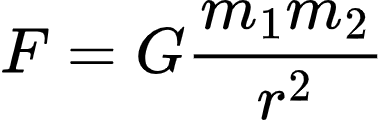
where
- F is gravitational force,
- G the gravitational constant,
- M Earth’s mass,
- m the object’s mass,
- and R Earth’s radius.
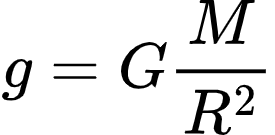
- We define gravitational acceleration
 For an object of mass m, we write
 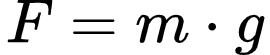 Take a 1‑kg object. By definition, in this reading, one liter of water has a mass of 1 kg.
- The force exerted by gravity on this object is then
 We introduce a practical unit: the kilogram‑force (kgf).
- By convention, we define :

Thus, the force exerted by gravité on 1 kg (ou 1 liter of water) Earth’s :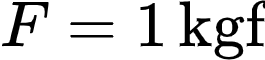
Result : For the ΛCDM, gravity on earth, applied to 1 liter of water, corresponds to 1 kgf.
QED
Gravity is therefore the expression of the GRID’s pressure on Earth’s surface — or on any spatial object. The denser an object is in matter, the more it deforms the GRID. It works like a slingshot: when the elastic is stretched, it thins and loses efficiency in supporting spatial objects approaching Earth. This is why such objects are attracted and, having progressively lost the support the GRID offered them, end up crashing onto its surface.
The GRID thus logically resolves many anomalies that trouble the ΛCDM. The problem is that this paradigm is not satisfied with gravity at large scales; it wants gravity at the scale of the infinitely small. The first serious and structured proposal for quantum gravity came from Matvei Bronstein in 1935. He suggested that gravity should also be expressed and calculated in the quantum regime, on the grounds that the gravitational field becomes unobservable below a certain scale.
During his lifetime, it would have been useful to reply to him that if gravity disappears at a certain point, it may simply be because it is no longer there. Apparently, he did not care, and his obsession was enough to drag the ΛCDM into a long, hopeless quest that, strangely, is still being pursued. For yes, gravity remains the stone in the shoe of the ΛCDM.
It is hard to understand why one refuses to accept that a tension effect cannot act on invisible, non‑geometric objects — which, for non‑specialists, is like being surprised that one cannot pat a ghost on the shoulder. So it seems useless to comment further on this waste of time and resources in such an absurd pursuit.
Just for the record, gravity is not the only property that exists only at the macroscopic level: temperature, friction, and pressure belong to the same category and interact only with geometric, perceptible objects.
It is also strange to imagine that a force — any force — could act at both levels. Just because you can tap someone on the shoulder does not mean you can high‑five a particle. A force that acts on structured, geometric objects cannot reasonably act on entities devoid of geometry.
The only coherent solution is therefore a purely geometric gravity — all the more so since it has resisted for a century every attempt to force it into a quantum reality.
Prediction
If a free‑fall experiment (such as MICROSCOPE) were to measure a deviation in acceleration depending on the composition of the objects, beyond instrumental uncertainties, then the hypothesis of gravity as a tension of the GRID — blind to matter — would be contradicted.