It is striking that, from the sole observation of intense light and rapid motion at galactic centres, one has built the improbable image of a black, invisible object that swallows matter. This interpretive feat is a remarkable example of how the standard model turns observations into ideology.
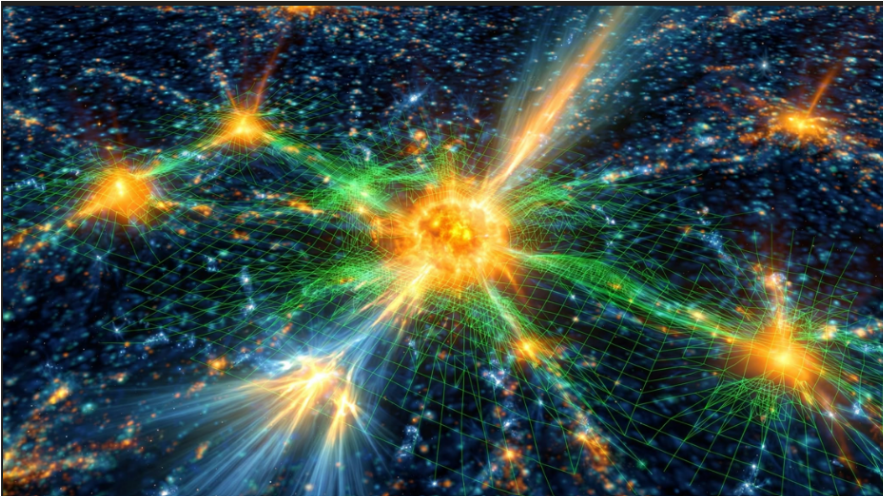
In the standard model, black holes are described as objects of extreme density, surrounded by an event horizon from which nothing can escape. They are said to be formed by the collapse of massive stars, and they are invoked to explain the intense luminosity and rapid motions observed at the centres of galaxies.
But this description is a curious interpretation, not an observation.
What is actually observed:
At the centre of most large galaxies, there is a compact, luminous source. This source emits intense radiation across a wide range of wavelengths: X‑rays, infrared, radio. Around this source, stars move very fast, in tight orbits. Jets of matter and energy are sometimes ejected along a preferred axis. The source itself is extremely small compared to the galaxy that surrounds it.
That is what we see. No hole. No singularity. No invisible object.
Observing the CMB/GRID
The CMB does not look like a flat, peaceful lake, but rather like a collection of intense zones. These regions are natural centres of emergence. And it is certainly why the universe's organisation is merely based on groups of objects like galaxies.
Where the GRID is dense enough, geometry emerges. This emergence is not a passive event: it is an active, energetic process. It produces heat, radiation, and motion. It concentrates energy in a small volume, creating a bright, compact region. This is what we observe at the centres of galaxies.
- The light and radiation come from the emergence itself.
- The rapid motion of stars is due to the pressure of the GRID on the emerging geometry.
- The jets are the expulsion of energy along the axis of emergence.
- There is no singularity, no infinite density, no absorption of matter.
- There is no horizon — only a region where geometry is still forming, and which remains compact because the emergence is not yet fully deployed.
This reading explains all the observations without invoking invisible objects, without postulating singularities, and without requiring the absorption of matter. It also eliminates the need for quantum gravity, which in any case, was, is and will always be unconditionally impossible.
Black holes, therefore, do not exist. These very bright galaxy centres are birthplaces of geometry — centres where the universe emerges by groups of objects, actively, from its own substrate.
Galaxies' persistent activity
The spiral structure of galaxies is the visible trace of a continuous quantum activity due to a probable permanent process of emergence. The direction of rotation is not really understandable and could be just aleatory and depend on the spreading fluctuations of quantum effervescence.
What actually happens is that galaxies are, poetically, living organisms with a beating heart that renews — through its quantum source, the GRID — its energetic capacity by continuously creating new stars, these energy-producing facilities. This cycle keeps the global equilibrium intact despite the end-of-life of existing stars.
The universe is not dying. It is closer to what mankind has sought since the dawn of time: perpetual motion.
In this case, at the centre, a quantum effervescence gives rise to multiple geometries at once — objects that do not appear in their final form immediately and obviously increase the mass of the centre so a powerful gravity is exerted.
The new objects first take on intermediate, lighter forms, orbiting close to the centre. As they mature, they grow in mass and gradually move outward, shifting to more distant orbits. This progressive migration, driven by the increasing maturity of the emerging objects, naturally produces a spiral pattern — without the need for dark matter or complex gravitational adjustments.
The case of black holes is a clear example of scientific negligence. The object was not observed, only deduced — a mathematical consequence of general relativity, pushed to its extreme. From that moment, it became untouchable. And when observations appeared that contradicted it — young stars forming where nothing should form — the model was adjusted, not questioned.
And if questioning stops, science stops. General relativity is a theory that may be false. It is false: since it rests on a
spacetime that has no physical existence. No one seems willing to consider it.
This is why ΛCDM is a ruin.
Black Hole Observations
Observation | Standard Interpretation | UG.NUG Interpretation |
Gravitational waves (LIGO/Virgo/KAGRA) | Ripples in spacetime from black hole mergers. | Ripples in the GRID, produced by the dynamics of emergent geometry. |
Spin (ΩH) | Rotation of the black hole's horizon. | Not a rotation of a horizon. It is a dynamic feature of the emergence zone. |
Surface gravity (κ) | Gravity at the event horizon. | Not gravity at a horizon. It is the local pressure of the GRID on emerging geometry. |
Ringdown | The black hole settling into its final state. | Not a black hole settling. It is the GRID returning to equilibrium after an emergence event. |
Event horizon | A "surface of no return." | Not a surface of no return. It is the boundary of a region where geometry is still forming. |
Pair-instability mass gap | Gap in black hole masses due to stellar physics; filled by hierarchical mergers. | There is no mass gap. Mass is not a property of these regions. What is observed is the distribution of emergence intensity. |
Spin populations | Low-spin (direct collapse) and high-spin (hierarchical mergers). | No low‑spin or high‑spin populations. Spin is a secondary effect of geometric emergence, not a product of mergers. |
12C(α,γ)16O reaction rate | Critical for nuclear astrophysics and stellar evolution. | Not relevant. These regions are not formed by stellar evolution. |
Pair-instability gap (m₂ only) | Evidence for hierarchical mergers; primary components in the gap are merger products. | No gap. The observed distribution reflects different levels of emergence maturity. |
High spins in gap binaries | Signatures of hierarchical mergers. | Not a signature of mergers. It is a signature of intense emergence. |
Low black hole masses (10⁵–10⁷ M⊙) | The lowest mass black holes known at high redshift. | Not a measure of mass. It is a measure of the intensity of the emergence zone. |
12C(α,γ)16O S-factor constraint | Links gravitational-wave astronomy to nuclear astrophysics. | Not relevant. This region does not involve nuclear astrophysics. |
Growth of light seed black holes at high redshift | Tiny black holes from Population III stars grow rapidly (~10⁴ M⊙) to become the seeds of supermassive black holes observed by JWST at z > 8. | No seeds, no growth. The observed objects are simply emergence zones at different levels of geometric maturity. Redshift is not cosmic time; it is a measure of geometric maturity. |